







By
Love wins? Same-Sex Couples Can Co-Own Property
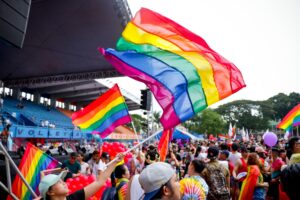
Photo by Kryss Rubio from the Metro Manila Pride March 2018
In this day and age, LGBTQIA+ (Lesbian, Gay, Bisexual, Transgender, Queer/Questioning, Intersex, Asexual/Aromantic/Agender, and more) community has achieved significant legal advancements to the extent that same-sex marriage is, as of this writing, legal and performed in thirty-eight (38) countries.
In the Philippines, the same-sex marriages remain void under our law. We are still limited to the compliance with essential requisites and formal requisites under the Family Code – one of the essential requisites being that legal capacity of the contracting parties, who must be a male and a female.
However, on 05 February 2025, the Supreme Court promulgated a Decision (G.R. No. 267469) resolving the property rights of a same-sex couple. In this case, A and B, a same-sex couple, lived together and bought a house and lot (“Subject Property”) but registered the title solely in B’s name for easier bank transactions. After their separation, B executed a document acknowledging that A financed and paid half of the acquisition and renovation expenses of the Subject Property. However, later, B refused to recognize A’s share, prompting A to seek partition of the Subject Property and lot and annotate an adverse claim on the title of the Subject Property.
In the Decision, the Supreme Court resolved the issue of whether co-ownership was sufficiently proven and in resolving the issue, the Supreme Court held that for same-sex cohabitants, property relations are governed by Article 148 of the Family Code which provides that co-ownership arises only upon proof of actual joint contribution and that the execution of a written acknowledgment recognizing the other’s contribution and share is binding and any ambiguity is construed against the party who authored it. Eventually, the Supreme Court found existence of co-ownership of the Subject Property between A and B and allowed the partition of the Subject Property.
Now the question, what is the effect of this 2025 case to the property rights same-sex couples, if any? Although, the LGBTQIA+ consider this a massive step forward for the property rights of LGBTQIA+ individuals and couples, in truth, there is no monumental change regarding the property rights of LGBTQIA+ individuals and couples. If any, the Decision merely emphasizes that same-sex couples who live together still do not enjoy the presumption of joint property ownership under Article 147 granted to couples who are capacitated to marry and remain bound by Article 148 wherein proof of actual contribution is required to establish co-ownership.
Albeit far from equal (legal) treatment provided to heterosexual couples who are capacitated to marry each other, the 2025 Decision is still an advancement for the LGBTQIA+ community, considering that it is a recognition of the existence of same-sex relationships and a clear rule on the property relations of same-sex cohabitants.
Author: Atty. Charlotte Francis Marie O. Ambas

By
Processing Bail and its Requirements upon the Filing of a Criminal Information
What is Bail?
For the unacquainted, learning that a Criminal Case and Criminal Information have been filed against yourself, a loved one, or a client, is a harrowing and challenging experience, particularly when a warrant of arrest will or had already been issued.
We find comfort and solace, however, in the constitutionally granted right of an accused to be presumed innocent until proven guilty beyond a reasonable doubt in criminal proceedings [1] and the complimentary right of an accused to be granted bail while the criminal case against them is pending.
Bail is the security given to a court for the provisional liberty of a person charged in a criminal case, for which a warrant of arrest has been or will be issued, to guarantee the appearance of the accused before any court as required. In other words, upon posting bail, an accused will not need to be detained while the criminal case is ongoing as long as any and all bail conditions are complied with. This allows the accused to adequately prepare their defense without the anxiety and difficulties of detention.
Bail may be given in the form of corporate surety, property bond, cash deposit, or recognizance.
Bail is not always available to an accused.
The right to bail upon the filing of a Criminal Information, however, is not absolute and is not available to an accused charged with offenses punishable by reclusion perpetua when evidence of guilt is strong. Article III, Section 13 of the 1987 Philippine Constitution states:
"All persons, except those charged with offenses punishable by reclusion perpetua when evidence of guilt is strong, shall, before conviction, be bailable by sufficient sureties, or be released on recognizance as may be provided by law. The right to bail shall not be impaired even when the privilege of the writ of habeas corpus is suspended. Excessive bail shall not be required."
Accordingly, if the Criminal Information charges an individual with a crime not punishable by reclusion perpetua, bail is immediately available as a matter of right and may be processed by a representative of the accused, preferably a lawyer of choice.
How to post Bail?
– Bail Requirements.
The Rules of Court and other issuances of the Supreme Court[2] of the Philippines specify the minimum requirements for the posting of bail. These requirements include:
- A notarized or sworn undertaking and waiver of appearance by the accused that they will appear before the proper court whenever required by the court or the Rules of Court and that failure to appear at the trial without justification and despite due notice shall be deemed a waiver of the right to be present. In such case, the trial may proceed in absentia;
- Four (4) sets of the accused’s mugshots or photographs taken within the last six (6) months showing the face, front, left, and right profiles, of the accused with name and signature at the back of each picture;
- Certified True Copies of the Criminal Information;
- Left and right handprints or fingerprints;
- Barangay Certification intended for bail purposes, reflecting the real name and residence of the accused;
- Location plan or house sketch of the accused, certified by the barangay;
- If the accused is detained by or voluntarily surrendered to the police in a place different from where the case is pending, a certificate of detention showing the name, designation, and signature of the personnel authorized to issue the certification;
- Payment of bail amount recommended or imposed by the Court;
- Certified copy of the Order specifying the amount of bail if different from the specified amount recommended in the Criminal Information;
- If bail is posted by corporate surety bond, presentation of the original certificate of accreditation and authority issued by the Court Administrator containing the photograph of the authorized agent and a copy thereof; and
- If bail is posted by property bond, the transfer certificate of title of the property and its latest tax declaration.
As stated in OCA Circular No. 204-2022-AA, the above requirements are only the minimum documentary requirements for posting of bail.
Thus, it is prudent and highly recommended that when a Criminal Information has already been filed and raffled to a specific branch of that court, a representative of the accused inquires with the court to ask for the specific bail requirements of that court. Some courts may require a specific format for the undertaking or dispense with and no longer require strict compliance with the above requirements.
Note, however, that several of the documents required for the processing of bail may be secured or initially processed even prior to posting bail, particularly the barangay certification and house sketch of the residence of the accused, which may be in a city or province other than where bail will be posted.
Upon completion of the requirements to the satisfaction of the court, an order of release shall be issued granting bail and the provisional liberty of the accused, setting for the conditions that must be complied by the accused.
Should bail or any of its requirements need to be posted or processed or should bail be initially unavailable, whether by insufficiency of finances or a recommendation of ‘no bail’ in a Criminal Information, we recommend immediately consulting a lawyer to be apprised of remedies available to your particular circumstances.
[1] Article III Section 14(2) of the 1987 Philippine Constitution.
[2] Rule 114 Section 2; OCA Circular No. 204-2022-AA; A.M. No. 04-7-02-SC.
By
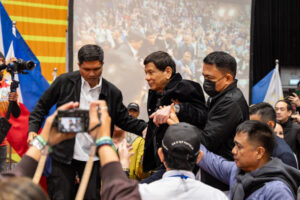
Rodrigo Duterte Arrested: Former Philippine President Faces ICC Charges Over Drug War Killings
Manila, Philippines — In a controversial and widely debated development, Rodrigo Duterte was arrested upon his arrival at Manila's Ninoy Aquino International Airport on March 11, 2025. The former Philippine president, known for his firm leadership and relentless campaign against illegal drugs, now faces charges filed by the International Criminal Court (ICC) related to his anti-drug efforts, which some critics claim resulted in extrajudicial killings.
Duterte's Arrest Raises Public Outcry
The news of Rodrigo Duterte's arrest has sparked a massive public outcry, particularly from his loyal supporters who believe that his war on drugs was a necessary action to protect the nation from the horrors of drug-related crimes. Duterte, who served as the country's president from 2016 to 2022, gained a reputation for his fearless stance on crime and drugs, significantly reducing criminal activities during his term.
Many Filipinos credit Duterte for restoring peace and order in the country. However, international human rights groups have been critical of his approach, alleging that thousands of lives were lost due to his tough anti-drug measures. Despite these criticisms, millions of Filipinos continue to admire and support Duterte for his bold leadership.
Duterte's Arrest and Legal Battle
Rodrigo Duterte was arrested immediately upon his return from a personal trip to Hong Kong. Philippine National Police (PNP) officials confirmed that they executed the arrest warrant as soon as his plane landed in Manila. Duterte was transported to Camp Crame, where he is currently detained pending legal procedures. However, many legal analysts question the validity of the arrest, given that the Philippines had withdrawn from the Rome Statute in 2019.
Duterte's legal team, led by former presidential legal counsel Salvador Panelo, strongly condemned the arrest, stating that the ICC lacks jurisdiction over the Philippines and that the arrest is purely politically motivated. "President Duterte only did what was necessary to protect the Filipino people. This arrest is a direct attack against a man who devoted his life to serving the nation," said Panelo.
ICC Charges Against Duterte
The International Criminal Court has charged Rodrigo Duterte with crimes against humanity, citing alleged extrajudicial killings during his administration’s war on drugs. However, many supporters and political analysts argue that the war on drugs significantly decreased crime rates and made communities safer.
"The people who benefited from Duterte's leadership are the ordinary Filipinos who could finally sleep peacefully at night," said one supporter outside Camp Crame. "This arrest is unjust and is an insult to a man who served the country with his heart."
Filipinos Rally Behind Duterte
Following the Rodrigo Duterte arrest, thousands of supporters gathered outside Camp Crame and in various parts of the country to show their support for the former president. Social media has been flooded with hashtags like #StandWithDuterte and #JusticeForDuterte, calling for his immediate release.
Many believe that the ICC’s arrest warrant is politically motivated and orchestrated by international forces that oppose Duterte’s radical methods in fighting crime. Meanwhile, human rights activists maintain that the arrest is a step toward seeking justice for the alleged victims of the drug war.
Need a Mobile App or Website Developer?
If you are looking to build a mobile app or a website, visit ServicioPro.ph — a trusted platform for hiring skilled app developers and web developers in the Philippines. Get your project started today with top-rated professionals.
What's Next for Rodrigo Duterte?
With Rodrigo Duterte arrested, the next step involves extraditing Duterte to The Hague, Netherlands, where he will stand trial before the International Criminal Court. However, his legal team is expected to mount a strong defense, insisting that Duterte's actions were in the best interest of the Filipino people.
Supporters remain hopeful that justice will prevail and that Duterte's arrest will only strengthen his legacy as a leader who prioritized peace and order above all else. Political analysts predict that the Duterte arrest may lead to intensified national debate about the role of international bodies in Philippine sovereignty.
By
Chiz Escudero: Duterte's Admissions May Signal a Step Toward Accountability for Drug War Killings
enate President Francis "Chiz" G. Escudero stated today that former President Rodrigo Duterte's recent statements during a Senate Blue Ribbon Committee hearing could signify an initial step toward taking responsibility for the violent drug war conducted under his administration.
While Escudero acknowledged that Duterte’s testimony largely echoed his previous statements from his time in office, he noted a key difference: this time, Duterte’s words were given under oath.
"Yesterday, every word he spoke was under oath. He swore that what he stated was true to the best of his knowledge. This can be used either in his defense or against him," Escudero said.
Duterte’s statements were officially recorded, with the hearing transcripts soon to be available for any interested parties and the general public.
Escudero emphasized that, unlike in the past, where Duterte’s spokespersons dismissed his strong statements on drug-related killings as jest, Duterte can no longer make this claim, having testified under oath.
"It seems he stands by what he did and said—he’s not hiding from it. His statement yesterday was clear: ‘I am willing to take full responsibility, just me.’ How that is implemented remains to be seen. Perhaps this is Duterte’s way of putting that sentiment into action, bravely facing and admitting to what transpired," Escudero added.
The Senate President pointed out that, despite the drug war killings during Duterte’s administration and his time as Davao City mayor, no charges have been filed against Duterte himself, nor against his Philippine National Police (PNP) chiefs or Davao City’s former police leaders.
"He is without a case. The former PNP chiefs and Davao City police heads are also untouched by any murder cases. The officers facing charges are those who, it appears, either followed orders or acted as they saw fit. They are the ones dismissed from service, imprisoned," Escudero said.
From Duterte's testimony, Escudero said the former President seemed "clear in his message."
Reflecting on his experience with Duterte, Escudero noted, "He often acts in unexpected ways. Perhaps his firm stance yesterday stems from a desire to bear responsibility, as time has passed, yet the consequences have largely fallen on low-ranking officers—not those at the top."
As a lawyer, Escudero underscored that the Constitution prohibits anyone from taking the law into their own hands, regardless of motive.
"The first clause in the Bill of Rights states that ‘No person shall be deprived of life, liberty, or property without due process of law.’ This foundational principle in our Constitution demands that human rights be respected, especially by the government and those in authority," Escudero stated.
"Even the government must uphold the process. A civilized government does no less than ensuring due process for all, no matter the emotional weight or urgency," he said.
Escudero concluded that it is now up to affected parties, particularly the families of the drug war victims, to determine their next steps in light of Duterte’s sworn statements.