Legal Insights
DOE Certification Opens the Door to Fuel Excise Tax Relief
Why the DOE’s certification under RA 12316 matters, how the President may suspend fuel excise taxes, and what households and businesses should watch next.
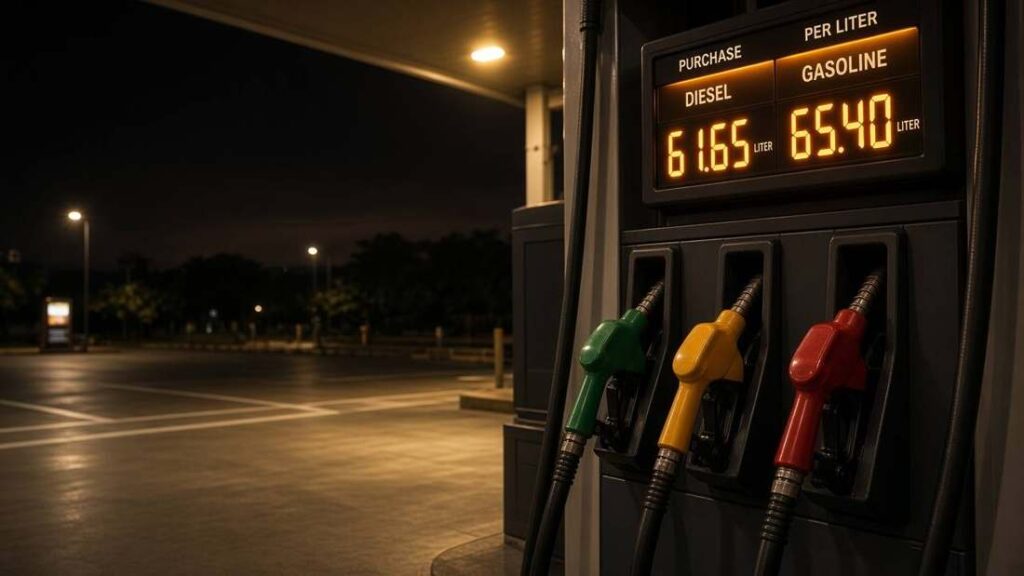
Why the DOE’s certification under RA 12316 matters, how the President may suspend fuel excise taxes, and what households and businesses should watch next.
Fortun and Santos Law Offices
The debate over fuel taxes in the Philippines often resurfaces whenever pump prices climb sharply, but the issue became more legally immediate on 16 September 2026 after public reports that Energy Secretary Sharon Garin certified that the one-month average of Dubai crude from 13 August to 11 September 2026 reached US$99.41 per barrel. That figure is important because it is above the US$80 threshold provided under Republic Act No. 12316, the amendment to the TRAIN law that created a mechanism for suspending or reducing certain fuel excise taxes when global oil prices stay high enough for a defined period. The certification has reportedly been transmitted to the Development Budget Coordination Committee, opening the door to an executive decision.
The law does not automatically erase the tax the moment the threshold is crossed. Instead, it authorizes the President, upon recommendation of the DBCC and the Energy Secretary, to suspend or reduce excise taxes on specific petroleum products for up to three months, in full or in part. Reports also indicate that the Department of Finance is inclined to propose a 100 percent suspension on LPG and kerosene. For households, transport operators, and businesses, the certification is therefore less a final relief measure than a legal trigger that now requires closer attention to what the executive branch does next.
How the Suspension Mechanism Works
To understand the significance of the certification, one must distinguish between policy debate and statutory design. The Philippines already collects excise taxes on fuel under the tax reform framework commonly associated with the TRAIN law. RA 12316 did not abolish those taxes; it added a safety valve. When average world crude prices exceed the statutory benchmark over the specified monitoring period, the executive may intervene temporarily. This is a calibrated power, not an unlimited one. The suspension can be full or partial, can target particular products, and can last no more than the period authorized by law unless renewed through a fresh legal basis.
This design matters because many public arguments treat fuel tax relief as if it were a simple political choice. In fact, the current system is rule-based. The executive must consider both the price threshold and the fiscal consequences. It is not enough for prices to feel high; the statutory trigger and recommendation process must be satisfied. Conversely, once the threshold is crossed and certified, government cannot honestly pretend that no legal relief framework exists. The certification changes the burden of explanation. Officials must now justify either action or inaction under a law specifically written for this moment.
Why LPG and Kerosene Are Politically and Legally Sensitive
The reported preference of the DOF for a full suspension on LPG and kerosene is understandable. These products are closely tied to household welfare. LPG affects daily cooking costs for families and small eateries, while kerosene still matters for vulnerable households and some off-grid users. Relief targeted at those fuels may therefore deliver a more immediate social impact than a broader but shallower reduction spread across multiple products. A product-specific approach can also limit revenue loss compared with suspending all covered fuels at once.
Still, targeting only some fuels will not end the argument. Transport groups, delivery firms, agricultural operators, and businesses exposed to diesel-linked logistics will ask why household fuels should receive full relief while road-based commerce absorbs continued tax pressure. The law allows differentiated treatment, but differentiation must still be explainable. The executive should articulate the criteria used, such as inflation impact, poverty sensitivity, fiscal space, and likely pass-through to consumer prices. Clear reasons reduce the risk that a legally authorized decision is dismissed as arbitrary or selectively political.
Revenue Versus Relief Under the TRAIN Framework
Excise taxes were never imposed in a vacuum. They were part of a broader fiscal package meant to raise revenue for public services, infrastructure, and social spending while correcting distortions in the tax system. That background explains why the suspension power is temporary and conditional. The state needs revenue, but it also needs flexibility when international oil shocks become severe. The legal question is therefore not whether taxes are good or bad in the abstract. It is whether the statutory balance between revenue and relief is being used as Congress intended.
From a law-and-policy perspective, that balance is difficult. Frequent suspension can weaken predictability in revenue planning and invite pressure whenever prices rise modestly. Refusing suspension even when the statutory trigger is met can undermine public confidence in rule-based governance. The disciplined solution is fidelity to the statute: verify the trigger honestly, assess the inflation and fiscal context transparently, and adopt a measure proportionate to the conditions. Lawful discretion is strongest when it is explained, not when it is merely announced.
The Consumer and Transport Impact
Rising fuel prices do not stay at the pump. They move through the economy through transport fares, freight rates, food distribution, utility operations, and the operating costs of nearly every small business. Jeepney and bus operators feel the impact directly. Market vendors feel it through delivered goods. Families feel it through both commuting expenses and household prices. This is why a legally technical certification by the DOE quickly becomes a practical matter for millions of people. Fuel cost pressure is one of the clearest channels through which global events become domestic hardship.
The government has also reported that fuel supply remains above 50 days, which is important because price stress and supply shortage are different problems. A country may have enough fuel physically available yet still face intense affordability pressure. The legal tools for scarcity are not identical to the legal tools for price spikes. Here, the immediate issue is not rationing but tax-mediated relief. That distinction matters for businesses deciding whether to hedge, adjust inventories, revise fare applications, or renegotiate delivery charges.
Inflation, Public Pressure, and Executive Accountability
Fuel tax suspension decisions rarely occur in isolation. They are made against a wider inflation backdrop, with political pressure from consumers, industry groups, and local officials. Yet pressure alone should not obscure the constitutional point: the President’s power in this area is statutory, not free-floating. Once the DBCC recommendation is made and the Energy Secretary’s certification is on record, the executive’s eventual action or refusal to act should be defensible as a lawful exercise of delegated authority. In a mature legal system, even emergency-leaning economic decisions should remain anchored in written standards.
That is also why public communication matters. If relief is granted, the government should specify which products are covered, the exact duration, the revenue effect, and the expected retail consequence. If relief is withheld or made partial, officials should explain why the statutory threshold was insufficient on its own to justify a broader move. A vague announcement may satisfy a news cycle but not the demands of accountable administration. Economic hardship invites populist shortcuts; the law requires reasoned decision-making.
- The legal trigger has reportedly been certified by the DOE
- The President may act only through the process authorized by law
- Suspension can be full or partial and can cover selected products
- Relief may last up to three months under the statute
- Households and transport sectors will watch how much price relief actually reaches them
What Businesses Should Document Right Now
Companies often focus on macro headlines and neglect their own evidentiary position. That is a mistake. Whether tax relief is granted or not, businesses affected by high fuel prices should document freight costs, generator consumption, transport surcharges, supplier notices, fare adjustments, and any contract clauses tied to fuel indexes or escalation. Proper records help in several ways. They support internal pricing decisions, justify renegotiation requests, assist tax and audit review, and strengthen legal positions if a dispute later arises over pass-through charges or alleged overpricing.
Transport operators and distribution businesses, in particular, should retain daily price logs and records of route economics. If relief is announced but downstream prices do not adjust as expected, regulators and counterparties may scrutinize whether businesses actually passed on the benefit. Conversely, if no relief comes and operating costs become unsustainable, documented evidence will matter in negotiations over rate increases, temporary surcharges, or revised service terms. In commercial law, proof usually beats complaint.
Contract Clauses, Surcharges, and Commercial Fairness
Higher fuel costs frequently lead to disputes about whether one party may impose a surcharge or adjust price without a fresh signed amendment. The answer depends on contract language. Some supply and logistics agreements contain escalation clauses tied to published fuel benchmarks. Others are fixed-price contracts that allocate cost risk to the supplier. Still others are silent, which pushes the parties into negotiation and, if relations collapse, litigation or arbitration. A possible excise suspension adds another layer, because it may change cost assumptions mid-contract.
Businesses should therefore review whether their contracts define taxes separately from commodity costs. If a surcharge was justified by excise pressure and that pressure is later reduced, continuing the full surcharge may become difficult to defend. On the other hand, if global crude remains elevated, tax relief may offset only part of the cost burden. Commercial fairness requires nuance. Neither buyers nor sellers benefit from pretending that a temporary tax measure solves every pricing problem. The best legal posture is clear drafting, transparent computation, and prompt written notice when cost assumptions change.
The Limits of Temporary Relief
Even a full suspension on selected fuels would not erase the structural issues behind Philippine energy vulnerability. The country remains exposed to imported oil prices, logistics constraints, currency movements, and weather-linked disruptions. Temporary excise relief can soften a shock; it cannot redesign the energy economy. That is why legal and policy discussion should not stop at whether the President suspends a tax this month. Longer-term questions about public transport modernization, cleaner energy transition, competition in fuel markets, and better social protection remain very much alive.
Still, temporary relief should not be dismissed simply because it is temporary. Law often works through limited interventions tailored to a specific risk. If the statutory conditions are met, using the tool can be both prudent and lawful. The important thing is honesty about what the measure can and cannot do. It can buy time for households, help temper inflation pass-through, and cushion vulnerable users. It cannot by itself cure global oil volatility or domestic income weakness.
A Test of Rule-Based Economic Governance
The present moment is ultimately a test of whether economic governance in the Philippines can remain rule-based under pressure. RA 12316 was written precisely so that government would not need to improvise entirely when oil markets spike. The legal architecture is already there. The threshold has reportedly been crossed. The certification has reportedly been transmitted. The public now waits to see whether the executive uses the authority transparently, proportionately, and with clear reasoning that balances fiscal responsibility and social relief.
For households, small businesses, transport groups, and commercial operators, the practical advice is to watch the formal measure closely and not assume more than the law actually provides. For policymakers, the lesson is that revenue laws are judged not only by how much they collect, but by whether they contain humane and workable relief mechanisms in times of stress. The next executive decision on fuel excise will be more than a tax announcement. It will be a statement about how seriously the government treats the law’s promise of responsive but disciplined intervention.
This article is for general information only and is not legal advice. For advice on specific fuel tax exposure, contracts, rate adjustments, or regulatory compliance, consult a licensed Philippine lawyer.